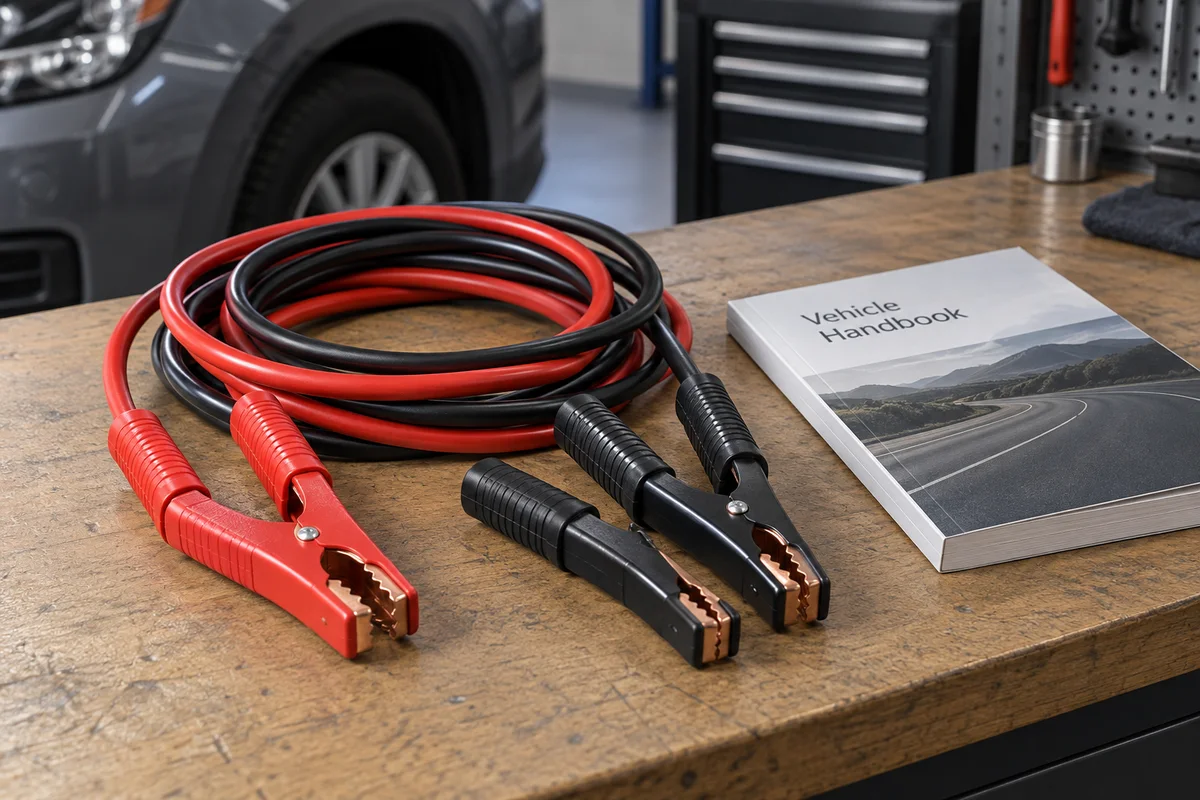
The handbook comes before the clamps
A jump-start is not one universal cable routine. Battery location, designated terminals, vehicle electronics and powertrain can change the procedure. Read the instructions for the disabled vehicle and for the booster or donor vehicle before positioning equipment. If the directions conflict or are unclear, use professional assistance.
Do not assume a hybrid or electric vehicle can serve as a donor because it contains a low-voltage battery. Some vehicles prohibit that role. Equally, the disabled vehicle may require remote connection points rather than direct access to its battery. The approved procedure is the deciding reference.
Rule out an unsafe battery first
Do not attempt to boost a battery that is swollen, leaking, unusually hot, physically damaged or suspected to be frozen. Keep flames, cigarettes and sparks away from the area. If there is a strong unusual smell or smoke, move away and contact assistance rather than investigating closely.
Battery chemistry and nominal voltage must be compatible with the equipment. A product advertised as a powerful booster is not automatically suitable for the car. Check its instructions and condition, including insulated clamps and undamaged leads. Do not improvise with household cables or exposed conductors.
Set up a safe place to work
Both vehicles must be secured as their manuals require, with adequate ventilation and no risk of unintended movement. Keep the equipment clear of fans, belts and hot components. An engine compartment is not made safe merely because the ignition was off a moment ago; some fans can operate unexpectedly.
Roadside traffic may make an otherwise familiar procedure unsuitable. Do not stand between vehicles or beside a live lane to connect leads. A recovery call can be the appropriate choice even if you have equipment and have performed jump-starts before.
Follow the exact sequence, including removal
Use the manufacturer’s stated connection and disconnection order, polarity and starting limits. This article deliberately does not substitute a generic diagram for those vehicle-specific steps. If you cannot positively identify a designated point, stop rather than choosing a convenient-looking metal part.
Never let clamps contact one another or bridge unintended terminals. Do not lean over the battery during an attempt. If the engine does not start within the prescribed attempts, end the procedure and seek help instead of increasing the experiment’s duration or changing connections at random.
Plan beyond the successful start
A running engine is the beginning of follow-up. Ask why the battery was unable to start the car and arrange appropriate charging and testing. Keep any remaining warning lights in the conversation, particularly a charging warning that stays on after the engine is running.